
‘Trickle down’ failed: time for ‘well-up’ economics
Professor Kevin Albertson (Department of Finance and Economics)
The policy change I would like to see discussed during the 2024 General Election campaign is a new standard for evaluating economic growth.
An important challenge the next government will face is that politicians of all leading parties have staked their reputation on, so-called, “returning to growth”. Before judging their policies, however, it is worth asking, what it is they hope to grow? And the answer is: GDP! But what exactly is GDP? According to the Office of National Statistics, Gross Domestic Product measures the sum of money changing hands in the UK economy.
It cannot have escaped anyone’s attention that the UK economy has had a difficult time of late. The election takes place at a time when Real GDP per capita (that is, the national level of spending per person, adjusted for inflation) has not substantially increased compared to before the Covid crisis. Many assume that because GDP is said to measure expenditure on ‘goods and services’, more of it will leave us better off, with more ‘goods’. However, GDP does not capture the affluence of the country. Many “economic bads”, such as ecological degradation are ignored and others, paradoxically, included. The economist Simon Kuznets suggested “economic bads” which should not count towards GDP include: advertising; financial speculation; debt interest; and the work-related costs, such as commuting.
The policy change I would like to see discussed during the general election is that GDP is therefore a poor measure of our economic wellbeing. I would suggest we judge our economy by how much we have to spend, proxied in the following graph by equivalised household real income (net of taxes and benefits).
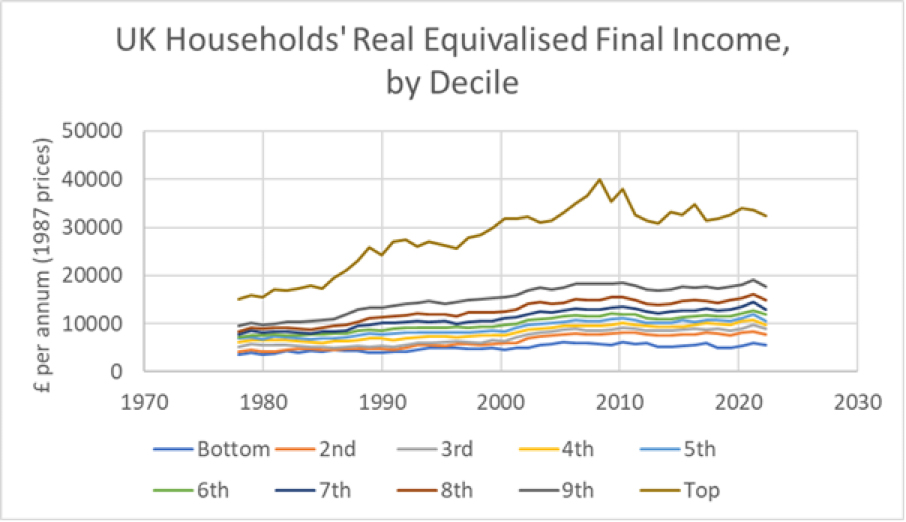
Data sources: ONS1, ONS2, ONS3 and authors calculations.
It is clear that, in the period from 1980 to 2008, the economically affluent, those who need the least amount of income growth, disproportionately benefited from government economic policies.
There is no evidence at all of the so-called “trickle down” effect which postulates that the best way to help the poor is to enrich the already affluent. This highlights another problem with GDP- merely increasing GDP completely ignores the distributional effects. Most of the economic growth goes to those people who need it the least.
If this policy was implemented, rather than consider GDP growth to be the measure of our economic performance, I suggest we consider the rate of increase in real household income of the bottom 10% of households. We should ask whether or not government policies support the economically vulnerable in becoming better off. This is the basic principle of “well-up” economics which argues affluence at the bottom of the income distribution will “well-up” through the economy and make us all better off. Rather than judging the government by whether (or not) they increase the amount of money changing hands every year, we should judge their performance by the rate of real income growth for those who need it most.
To find out more about this research, go to: Bristol University Press | Responsibility Beyond Growth – A Case for Responsible Stagnation, By Stevienna de Saille, Fabien Medvecky, Michiel van Oudheusden, Kevin Albertson, Effie Amanatidou, Timothy Birabi and Mario Pansera
