
Resources
MetroPolis develops resources to help researchers, practitioners and policymakers interact. We also provide training for researchers seeking to influence policy.
Resources
MetroPolis develops resources to help researchers, practitioners and policy makers interact. We also provide training for researchers seeking to influence policy.
Useful organisations
Everything you need to know to engage with Parliament as a researcher.
[Research impact at the UK Parliament]
UK Parliament and useful guides
[Research-impact-at-the-uk-parliament what-next]
A series of training sessions for PGRs and ECRs from UK Parliament
The Policy Lab
The Policy Lab is a team within the Civil Service focused on best practices in policy design with a particular focus on people-centred approaches. They have a useful blog https://openpolicy.blog.gov.uk/
In 2022 they launched guidance on a set of 11 experimental policy methods:
Capabilities in Academic Policy Engagement
Capabilities in Academic Policy Engagement (CAPE) is a partnership between University College London and the universities of Cambridge, Manchester, Northumbria and Nottingham, in collaboration with the Government Office for Science, the Parliamentary Office for Science & Technology, Nesta and the Transforming Evidence Hub. They host excellent policy events and a have series of useful policy guides, including the 221205-CAPE-Toolkit.
You can find all their resources on academic policy engagement, including on Areas of Research Interest and policy fellowships, on their website:
The Open Innovation Team
The Open Innovation Team within the Civil Service works across the public sector, including with academics and is focused on innovation in policy design:
The Institute for Government
The Institute for Government (instituteforgovernment.org.uk) is a think tank that focuses on the workings of government and policy-making. They have published a useful guide for academics on how to engage with parliament and politicians: [Go to this resource]
The National Co-ordinating Centre for Public Engagement (NCCPE)
(publicengagement.ac.uk) is funded by UK Research and Innovation, the devolved Higher Education funding bodies, and Wellcome. It publishes useful information on how to engage with policy-makers:
The Knowledge Exchange Unit
The Knowledge Exchange Unit at the UK Parliament supports the exchange of information and expertise between researchers and the UK Parliament:
The LSE
The LSE has a number of policy-related blogs (https://blogs.lse.ac.uk); particularly relevant is the LSE Impact Blog: [Go to this resource]
The What Works Network
The What Works Network aims to improve the way government and other public sector organisations create, share and use high-quality evidence in decision-making. The network is made up of 10 independent What Works Centres, 3 affiliate members and one associate member. Together, these centres cover policy areas which account for more than £250 billion of public spending. Each Centre focuses on a specific policy area and synthesises evidence related to that policy and seeks to fill gaps in the evidence-base:
Evidence-Informed Policy Making
The Evidence-Informed Policy Making team is part of the Knowledge for Policy: Concepts & Methods Unit at the European Commission’s Joint Research Centre (JRC.H1). Its main aim is to support researchers and policymakers to build and establish better connections between scientific knowledge and policymaking:
Useful publications
Transforming Research and Policy
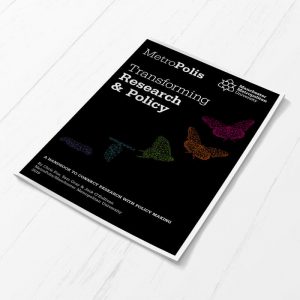
A handbook on connecting research with policy making – MetroPolis
How to Write a Policy Brief
Presentation slides on how to write a policy brief, published by the International Development Research Centre (IDRC)
CAPE Policy Toolkits and Templates
(June 2024)

CAPE toolkits are designed for knowledge mobilisers who are seeking to kickstart or increase engagement between universities and policymakers. They are practice-based, easy-to-digest, and intended as a starting-off point for people to adapt to their own work and contexts
Areas of Research Interest (ARIs) (February 2023)
This paper outlines a summary of themes found in departmental Areas of Research Interest in the UK Government and opportunities for academic-policy engagement.

HM Treasury publishes guidance on policy evaluation in The Magenta Book (Magenta Book) and on how to appraise policies, programmes and projects, including using economic evaluation in The Green Book [Go to this resource]
The World Health Organisation published guidance on evidence-informed decision-making: WHO (2021) Evidence, Policy, Impact.
[Go to this resource]
What counts as evidence for policy – Wales Centre for Public Policy (January 2023)
Our research aimed to improve understanding of what evidence means to different policy actors in Wales.
How to influence policymakers
You need to fully understand how Parliament works to engage with it
Little Book of Evaluation Tools – Public Engagement
This guide highlights a series of easy-to-use methods to evaluate the impact of Public Engagement with Research activities.
Meaningful Youth Engagement in Policymaking and Decision-making processes – UN
A detailed guide to ensuring that youth engagement is more meaningful and effective – from the perspective both of youth constituencies and of policymakers.
The Power of Partnerships: How to maximise the impact of research for development – Institute of Development Studies (IDS)
A research publication exploring practical opportunities and approaches for research policy partnerships to make a stronger contribution to development policy and practice.
The Dos and Don’ts of Influencing Policy
In this review, Kathryn Oliver and Paul Cairney examine the “how to” advice in academic peer reviewed and grey literatures on how academics can influence policy making. They identify 8 specific recommendations on how researchers can collaborate with policy makers, and highlight a number of issues that academics within this field should be aware of.
Webinars
‘From Harm to Hope’: Opportunities and Challenges for Criminal Justice and Social Work Professionals – Wednesday 28th June 2023
Exploring the impact on probation work and social work of Dame Carol Black’s review of drugs and the subsequent 10-year government strategy with Professor Robert Ralphs (Manchester Metropolitan University), Ellie Reed (Change Grow Live) and Kevin Ball (HMI Probation).