
Introducing the Institute for Children’s Futures: Enhancing Manchester Met’s Policy Impact.
The Institute for Children’s Futures (ICF) at Manchester Metropolitan University has rapidly grown to over 170 members by February 2025, just three months after its launch. This impressive expansion highlights a strong demand for a new, collaborative approach to research and policy affecting children and young people. The institute was introduced with a national conference that brought together Manchester Met academics, professional services, policymakers, practitioners, and service providers, reinforcing the appetite for interdisciplinary cooperation.
Before the ICF’s establishment, Manchester Met had various research strengths related to children and young people, but these were dispersed across the University. Now, the ICF unifies these areas under a single brand with clear leadership, governance, and a research framework grounded in children’s rights and participatory approaches. This consolidation strengthens the university’s research excellence and enhances its ability to drive meaningful change by influencing policies relating to children and young people. By improving outcomes for children, the ICF contributes to stronger families, communities, and society as a whole.
With expertise in child participatory methods and interdisciplinary research, the ICF advances children’s rights and promotes evidence-based measures to improve their health and wellbeing. Its influence extends from regional and national levels to international collaborations. The institute aligns with Manchester’s ambition to become a UNICEF UK Child Friendly City, with Paul Marshall, Deputy Chief Executive of Manchester City Council, recognising the ICF’s role in shaping evidence-based policy and practice that prioritises children and young people.
Manchester Met’s research community, now consolidated within the ICF, spans a wide range of critical areas, including safeguarding, child health and wellbeing, youth justice, participation and rights, children with disabilities and learning difficulties, mental health, and more. Over the next two years, the ICF will focus on key research themes, including child participatory methods, defining child-friendly cities, mapping inequalities among young people in Manchester, and identifying effective strategies for improving children’s health and wellbeing.
The ICF recognises that making a lasting impact requires collaboration across sectors, engaging policymakers, practitioners, and professionals working with children. By translating research into accessible insights for policymakers, conducting studies driven by children’s needs, and identifying barriers to positive outcomes, the ICF aims to drive systemic change. Its success will be measured by its impact on advancing children’s rights, fostering participation, and delivering better futures through partnerships and evidence-based interventions.
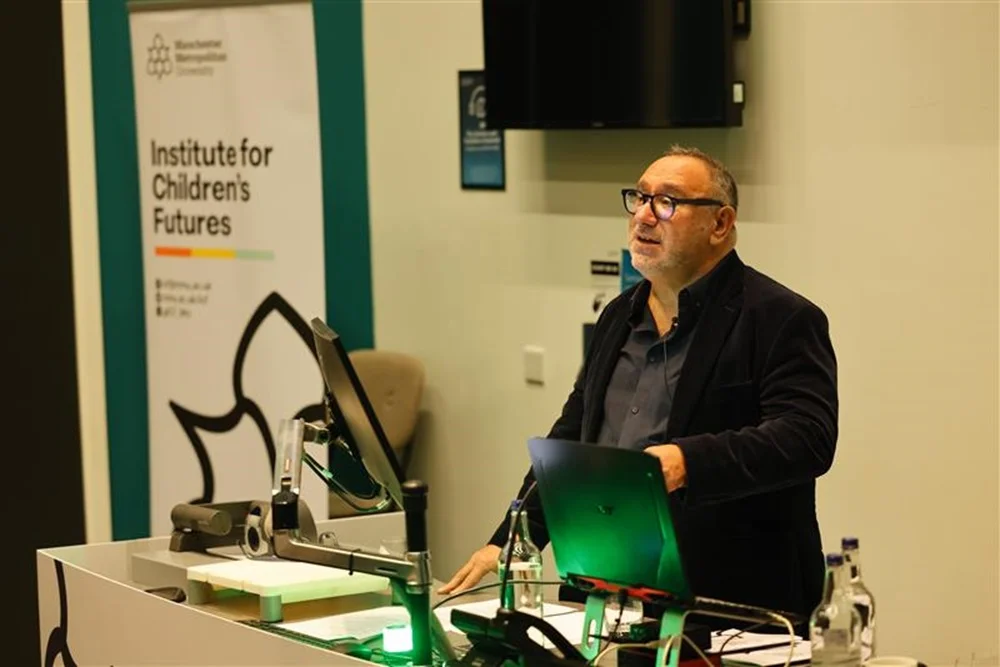
Professor Saul Becker, above, speaking at the ICF launch in November.