
Heritage and Place: addressing evidence gaps within policy and evaluation
By Dr Tamara West, CherPP Project Lead and Fellow in Place
In the Cultural Heritage, People and Place (CHerPP) project our work addresses a nationally framed research call and related policy approach, responding directly to the Department of Culture, Media and Sport’s (DCMS) Culture and Heritage Capital Framework. However, our project is also inherently regionally focused. We work with our research partner National Museums Liverpool, using their Waterfront Transformation project as a lens through which to explore how cultural assets can be better captured, evidenced and valued.
Stepping outside of the CHerPP project, but together with my CherPP Co-lead Prof Rafaela Neiva Ganga (LJMU), I was commissioned by DCMS to undertake a ‘Rapid Evidence Assessment’ to research the impacts of changes to Local Authority funding on small to medium sized heritage organisations. Our full report can be accessed here.
Culture and heritage are often prized as being key to community, connectedness, economy, and wellbeing. But when council budgets are increasingly squeezed, with several UK Local Authorities declaring, or close to declaring, bankruptcy, funding to culture and heritage is often the first thing to be cut – with the consequences affecting deprived areas and their communities the most.
Adopting a regional case study approach, we focused our evidence gathering research on the West Yorkshire Combined Authority. The region has a wealth of diverse cultural heritage assets and initiatives, but its councils face significant budgetary challenges. Some have issued Section 114 (bankruptcy) notices and have had to make very difficult choices. This has had a significant effect on smaller heritage organisations. Heritage sites and collections, especially community and council run sites, are often central to local communities and place-based agendas but cuts over a number of years have resulted in reduced services and in some curtailment of access to public heritage.
We interviewed representatives from each of the 5 Local Authorities, and we undertook 8 qualitative case studies of diverse small to medium sized heritage organisations, including council-run and community asset transfer sites. This was supplemented by a systematic literature review in order to frame the case studies within a wider national operating context.
The case studies evidenced that heritage is place. As one respondent put it: “We couldn’t be anywhere else”. There are, however, several risks. Intangible heritage organisations are key to local communities, but face uncertainty due to short term funding allocation models. Council-run cultural heritage sites that are central to local and in many cases national cultural offers have faced successive reductions in funding but continue to offer space for communities and to amplify the uniqueness of their districts, though there is an increased need for them to be entrepreneurial, often stretching staff and remit. Volunteers running community asset transfer sites and community heritage trusts act as guardians and advocates for place-based pride, education and identity, and their sites often become catalysts for place-based growth, as well as cross-community initiatives and wellbeing. Loss of, or limited access to public heritage can impact across communities for that very reason.
Two things cut across both our completed rapid evidence assessment and our ongoing CHerPP project. Firstly, the need to find more robust ways of evidencing the diverse benefits of culture and heritage to adequately value -and fund- it. Secondly, the value -and need- for the regional approach. To understand the values of heritage we need to understand how it intersects across communities, geographical scales, and usages.
Do check our CHerPP website for details of emergent findings, events, and plans, as well as the DCMS CHC portal for details of the other funded projects and any shared events or outputs.
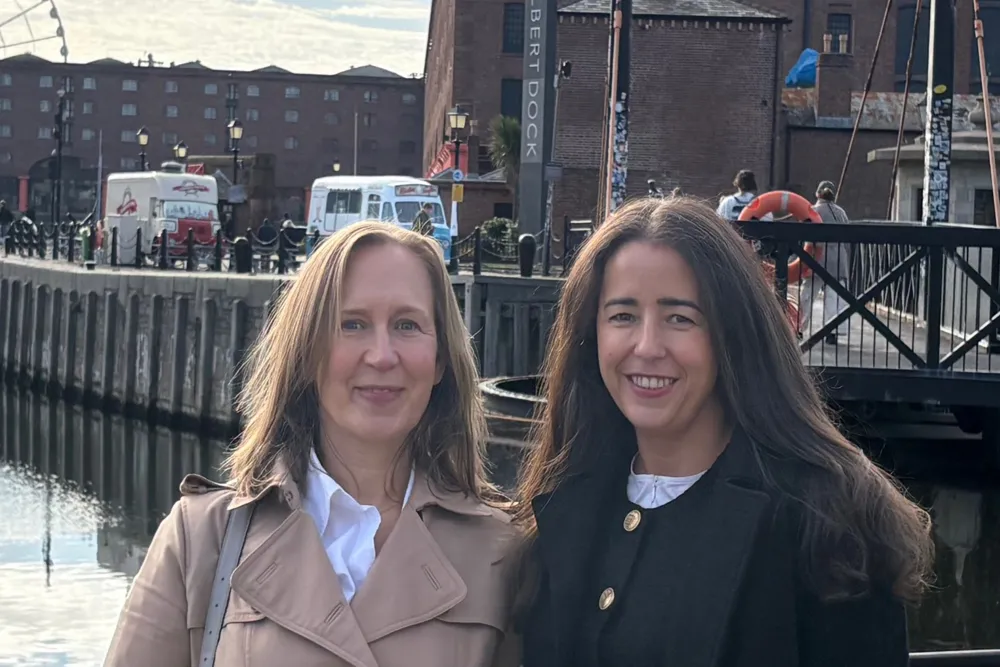
Dr Tamara West (left) with research Co-lead Prof Rafaela Neiva Ganga from Liverpool John Moore’s University, at the Albert Docks in Liverpool.