
From Jury Research to Policy Change: Presenting Evidence to the House of Lords
Dr Hannah Fawcett and Dr Matt Brooks (School of Psychology, Faculty of Health and Education)
It is typical that just two days before the beginning of our much anticipated and much needed annual leave, one of the greatest opportunities for our research to have an impact on policy arrived in our email inboxes; an invitation to the Justice and Home Affairs Committee Inquiry into Juror Support. We have spent several years researching the impact of jury service on the wellbeing of individuals, and this invitation requested our expertise in developing the inquiry questions as well as an invitation to submit both written and oral evidence to the committee over the coming weeks. As researchers, we are used to sharing our work with academic audiences. Having the opportunity to discuss our research directly with policymakers was something entirely different.
Naturally we could not pass up on such an important opportunity to influence juror policy, and spent the next few weeks researching, writing and preparing evidence for the inquiry. As neither of us had written for this political audience before, we were grateful to accept all the help available from the Metropolis team, Showrunner Communications, and Manchester Met Communications Manager Simon Wilde. Together we drafted responses to the Inquiry questions and prepped for our journey to Westminster to present to the committee. The experience reminded us that impactful research rarely happens alone. Communicating evidence beyond academic circles requires a different set of skills, and the support we received was invaluable.
Arriving at Westminster, we felt the same sense of trepidation, nerves and excitement we experienced going into our PhD Vivas. Not only would we be questioned on our research by the committee, but our evidence was also to be live streamed and recorded on parliamentlive.tv. We couldn’t help but feel the gravitas of the situation as we stepped into the beautiful Palace of Westminster and walked through impressive long oak panelled corridors and marble floored halls. The setting itself was a reminder that research can sometimes reach audiences far beyond universities. A friendly pre-session chat from the committee chair, Lord Foster of Bath, was much appreciated in clarifying the format of our evidence session and outlining additional questions that we were to be asked.
Once the meeting started, we soon entered our stride and felt confident drawing on our research findings, consultancy and interactions with jurors to inform the committee. The committee seemed genuinely interested to hear of the multifaceted challenges, the high prevalence of psychological distress, and the lack of support services available to jurors. As well as discussing the challenges, we were pleased to share the positive experiences that some jurors can have, the value of court staff in supporting wellbeing, and the seriousness with which jurors take their role. Perhaps most encouraging was seeing how seriously the committee engaged with the evidence. It was clear that juror wellbeing was being considered as an important policy issue rather than a niche academic concern.
When we started this programme of research, we expected a small-scale project predominantly of interest in academic circles. Like many research projects, it began with a relatively simple question and degree of curiosity about an underexplored issue. In many areas of research, evidence develops over years or even decades before attracting the attention of policymakers. Our experience has felt somewhat different. Interest from policymakers, practitioners, the media, and former jurors has grown alongside the research itself. While our studies have already highlighted important challenges relating to juror wellbeing, the experience also reinforced how much there is still to learn. Several of the questions raised during the oral evidence session reflected issues that researchers have only just started to explore. For us, the experience was not only about sharing what we know but also being honest about what we do not yet know. In many ways, the inquiry felt less like the culmination of a research programme and more like a reminder of the important questions that still need answering.
We could not imagine the level of interest and impact our work could have on policy makers, the public and the media, and individual jurors making sense of their experiences. We left Westminster with a sense of pride, elation and hopefulness that our recommendations may be proposed by the committee to the government and make a tangible impact on the experiences of tens of thousands of people that undertake jury service each year in England and Wales.
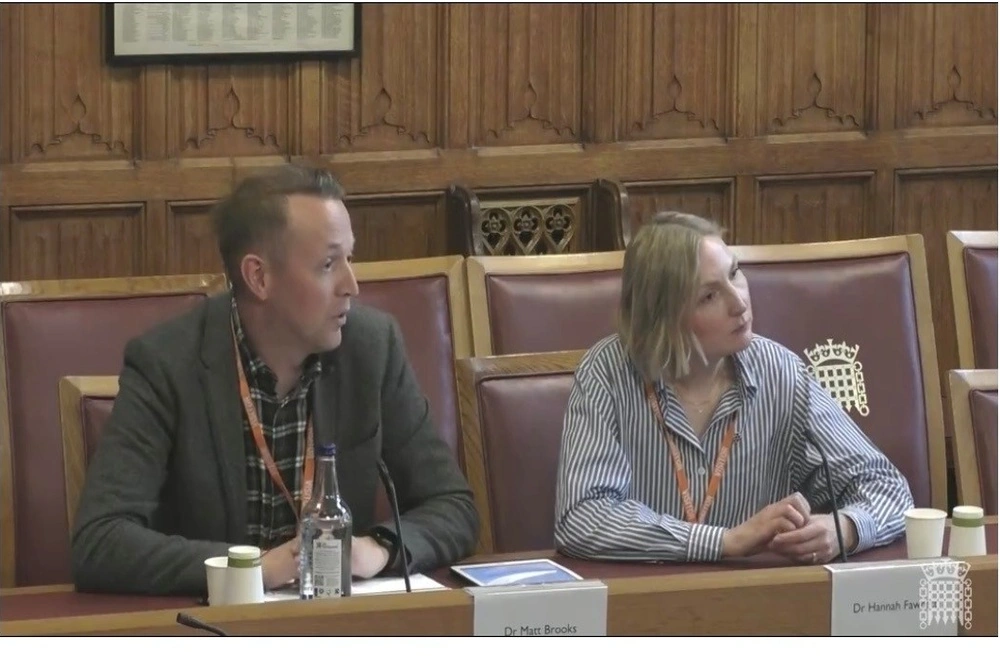
Dr Hannah Fawcett an Dr Matt Brook giving evidence at the Justice and Home Affairs Committee Inquiry. This meeting can be viewed on the parliamentary website here.